
Tuesday, June 12, 2012

Dad, I'd like to talk.

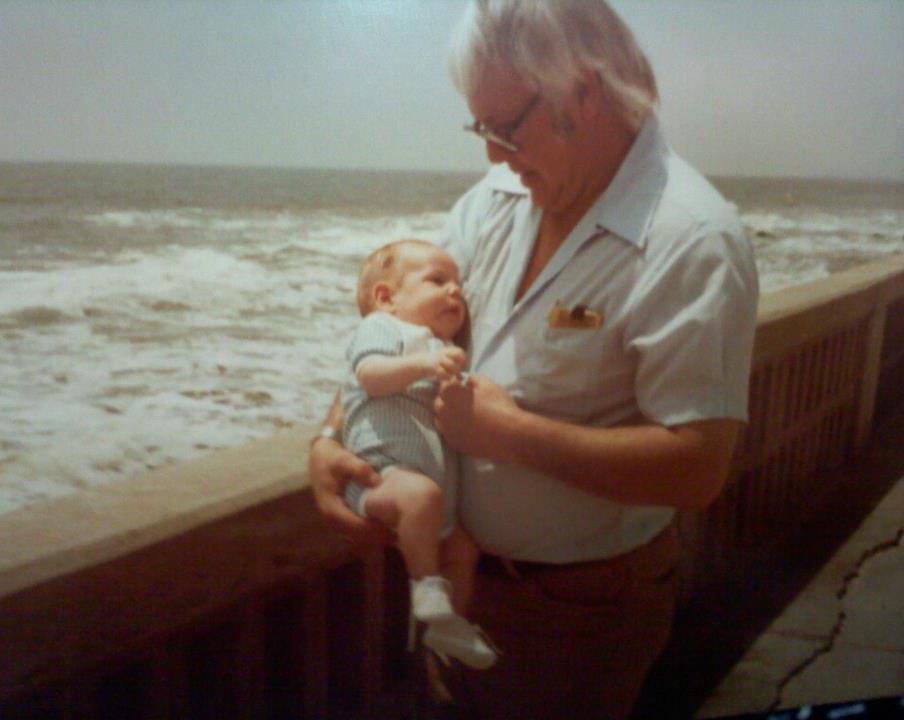
Every summer, back when my dad was still alive, my parents and I would go to the Isle of Palms. This was a summer tradition. I didn't realize how lucky I was then, but by God I know now. Trips to the beach, to beautiful Charleston, to Patriot Points Naval and Maritime Museum. I have been aboard the USS Yorktown so many times, I could probably give you a tour.

My dad loved the aircraft museum. He was a quiet man, but he grinned like a kid when he'd look at the Hellcat in the hangar. I was partial to the F4J-Phantom. I think his love for the aircraft came from his Air Force days. Before he was a civillian pathologist, he was in the AF during the 50's and 60's. He was actually trained to fly a few larger aircraft, although his primary job was to practice medicine. Sometimes when I go to Tennessee, I go to the garage and I find his flight helmet. I pick it up. I wonder. He really loved the Air Force.


And of course I find his stethoscope. An old blood pressure cuff. Even a black doctor's bag. I brush the dust off of these things, and I talk to my dad.

"Why didn't you tell me this world was a mad house?"

OR

"How did you survive the death of your first marriage?"

OR

"I'm doing the best I can. I really am."

OR

"Thank you for being a kind, wise, loving father, and not a jerk."

BUT MOSTLY

"I miss you."

If you have a loved one who's died, it's likely you talk to them too. I don't suppose I'll ever stop.

These days I am trying to recover something from the past. I've always been interested in the past. Anyway, I've decided that the symbol of this "recovery act" is my own body. I'm trying to eat well. Trying to exercise. I've lost thirty-five pounds so far. This means I weigh about 268 pounds. In high school, when I played football and wrestled, I weighed in the 190-205 range. Dad got sick in April of 1996. Died a few months later. I kind of just gave up after that. But now I've decided a change in policy is in order.

I know that getting to 200lbs again won't bring my dad back. But this process, for me, is about bringing something of myself back. It is about a journey to a place better than Charleston... or ANY city. Walt Whitman wrote a poem entitled, "Passage to India." In this poem he celebrates the great technological accomplishments of humankind. Laying down telegraph wire across an ocean... circumnavigating the globe... You'll remember that centuries ago, Europeans were obsessed with a shortcut to India. Finding a "passage to India" was a symbol for progress, and indeed, Whitman heaped praise upon the advances made over the centuries. But he laid a bold charge down for the reader at the end. We are charged to take "passage to MORE than India." Despite the technological advances, Whitman felt that the last great frontier was spiritual.

I do hope to return to Charleston again someday. I hope to return with people I love. But my deepest hope is to passage to more to India... to go more deeply into my own heart... more deeply into the heart of God. I imagine that I bring my dad with me in this journey, and all the people I love. With such good company, I know that I will not fail. And who knows what I might find?


Monday, June 11, 2012

Anton's Syndrome

Today I learned about Anton's Syndrome. There are two symptoms of this stroke-induced disorder. The first is "cortical blindness." There's nothing wrong the eyes, it's that the part of the brain that translates what the eye sees is damaged, so that the person is blind. If it seems strange that a person with perfectly healthy eyes can be blind, then consider the next symptom... The patient is unaware that they are blind.

The doctor said that this was a less common syndrome. And truthfully, it's hard to imagine that it exists. Blind people who are not even aware that they are blind. So they will go to the doctor's office, and they will flat out deny to the physician that they are blind. So the good doctor asks the patient, "What does my tie look like?" And the patient answers. Of course, the description is wrong. He's blind, remember? But the patient actually believes he is seeing the doctor's tie. It's not like the patient is lying. His brain supplies an image for the "mind's eye," and it is as real to the patient as the brown dog I see lying at my feet. Of course, one could question the reality of my perspective. This goes to the old philosophical question of whether or not we are seeing "things in itself," or merely "representations of ideas." But that's not the dog I'm gonna send to go hunt. Not tonight anyway.

As I said, Anton's Syndrome isn't common. But I personally feel acquainted with it. Maybe you do too. Seems like we go about life, assuming that our common sense is actually common. We assume that we see things as they are. We're a practical people. And we trust our senses. But should we? Don't we all have "blind spots?" This can be particularly frightening if we are driving our cars. We prepare to merge into the next lane. We check our mirrors, we glance over our shoulder, and begin our drift... only to be honked at! A man drives by and you can't hear a word he's saying. But you know what he's saying. You know. And it scares us terribly... to be waylaid by unforeseen blindness.

As dangerous as this can be on the road, there is are places where eyes that normally see 20/20 fail to catch the light. That place is called "Love." Ain't nobody got an eagle-eye as far as Love is concerned.

This is because love involves people, and people are an ever unfolding mystery. Friendship is not dissimilar. Any type of relationship wiggles out of ability to apprehend it entirely. We see what we see... in others... in ourselves, for reasons we can scarcely comprehend. We see an enemy possibly because we have an enemy. Or maybe we merely need one. Maybe you know what I mean. We've all pointed an accusing finger at some whipping boy. "It's that bastard's fault I said... did... feel... etc." The opposite is often true. We need an ideal. A hero. Someone to adore. People do this to their ministers. We're expected to be "better," more pure. Our families are more orderly. We have calm, Spirit-rich lives. If we have any faults, they're laughable. We're Ned Flanders. We're sexless. I remember putting my pastor on a pedestal... with golden intentions. Of course, he never was a real person to me. He was a priestly function. An "enter" key that I could press to start a new paragraph.

We also do this to lovers. I was once accused to putting someone on a pedestal. She smiled when she said it. Joked with me and asked me if "Wonder Woman" had any faults. I smiled. I hurt. While I have put women on pedestals before, I realize now the pitfalls of such wide-eyed praise. When we elevate our Loves in impossible ways, when we refuse to acknowledge their limitations, their outright faults, or at least the things about them that drive us crazy, WE MISS WHO THEY ARE!

Wonder Woman's words hurt. I wondered, "Does she believe that anyone who really knows her would find it hard to love her?" And maybe my pride was hurt a little. I think I see things... people... pretty clearly. I believe I have the courage and the will to see others "as they are."

I know now that this is not always true. Sometimes, whether I'm pointing at a scape-goat or at someone I admire, I am actually pointing at my own blindness.

The heart is a dark place. We can barely know our own hearts, and it is faith that lets us feel like we can know another's.

Another word for "Faith" is "Trust." In the end, life requires a lot of Trust from us. It is a key ingredient in the recipe for love and/or friendship. It is essential for the reading of our own souls, because it's our soul that will tell us where to go, what to do. It is where God speaks. And even though we often see and hear God according to our own needs and conveniences, we "see through a glass darkly," as St. Paul says... we still catch a few glimpses.

The patient with Anton's Syndrome may not be physically able to trust the doctor's diagnosis. But we can accept our blind spots if we have the courage to acknowledge them. We might not ever see anything very clearly, but who knows... with a little trust, and a lot of love... we might get some of this Life stuff right.

Sunday, June 3, 2012

Currency

I once met a dying actor. He enjoyed a "hey, it's THAT guy" sort a fame. Had a few guest roles in a few tv shows in the 80's. Was in a few B movies. Had a supporting role in one big movie. He had cancer.

"There is one thing I have learned," he said in a soft voice. "It's that money can give us a false sense of security." I was a CPE resident at the time, making half of what I make now as a professional staff chaplain, and what I make now makes me the poorest person you know with a Masters degree from Wake Forest University. So I was curious about this man's comment.

I had learned that a LACK of money gives me a very real sense of insecurity. Of course, I knew that money wasn't the panacea that our culture makes it out to be. If I had made money my goal, I'd have chosen a profession that commands a lot of bank. It's not that hard. Or it's no harder than what I do now. In any case, I feel fortunate. I have meaningful work, and I make enough. But when I was a resident, I did not make enough. Still, I listened to the patient.

"Take this cancer for instance," he said. "No matter how much money I throw at this, I'm going to die."

All of a sudden my mind is filled with literary and film references. Remember in the Jodie Foster movie Contact? She has a benefactor. A strange, some would say deranged, billionaire. He is riddled with cancer and as a last resort has paid for transport up to the Russian space station Mir. Apparently the zero G environment slows the progress of cancer. That's probably not factual (I mean, have studies been done on this? If I were an oncologist I would absolutely want to look into this, but only if it meant a trip into space). In any case, Mr. Twisted Benefactor of Jodie Foster ended up dying.

In the Michael Crichton novel, Next, there is, yet again, another billionare who runs into deadly health issues. He too, attempts to throw money at the problem. He owns a biotech company that does research on the cutting edge of gene therapy. At the end of the book, despite his mindblowingly vast resources, this man dies on the operating table.

Of course, this is fiction. It is also true. The movie star did eventually die, and his words have remained with me.

It strikes me that the acquistition of wealth is yet another attempt to control reality. To a limited extent, the wealthy DO have a lot of control. Certainly corporations "too big to fail," or those with money to invest in controlling our political leaders, have some degree of power.

But they still don't have the capital that really matters. They have a limping currency that only goes so far. Despite the "lording over" quality that many executives exhibit in their lives--just look at Donald Trump and his ability to make pronouncements for the world to hear, despite his lack of anything substantial to say--each of them will die. But even in the middle class, we live in the vale of illusion. Our climate controlled homes buffer us from the elements, our cars allow us a quality of convenience unheard of in the vast span of human history, our Medicine can temporarily pull us from the jaws of death... a person "dies" on the table, but medications and electricity can revive them. But what is any of this worth if no one considers the essential things?

The only currency worth a damn is love.

People living in abject poverty understand this. It is tempting for us living with air conditioning to sentimentalize "the poor" as merely salt of the earth folk. The truth is, they can be just as wretched as the rest of us, though their lives are shorter and more brutish than ours. I'm not going to go into Somalia expecting to find entire populations of centered, wise, contented people. However, there are people living in these hells-on-earth capable of experiencing and enjoying love. They have fewer distractions from mortality than we do, but some people have discovered that which makes life worth preserving and fighting for: Love.

We don't have much control over the universe. Despite the optimism of the movies, if an asteroid careens towards our planet, there is nothing we can do to stop it. Nuking a Texas sized asteroid is a fantasy. If said asteroid comes calling, we will be obliterated. If the sun goes beserk, we die. WHEN another ice age comes, many of us will die. Cancer will keep on coming, but even if we cure that... old age will surely get us.

Some people figure, "Hey, no problem. I'm going to Heaven anyway." But if THIS life didn't matter, Jesus wouldn't have spent his life teaching people how to live in. Whatever happens post-death... and no one knows for sure... we have the opportunity to love God, to love others.

So if you are tired of spending yourself for the woefully limited currency of money, consider investing yourself in Love. It's stock has never gone down, and it will prove more sustainable than Facebook.

But if you win the lottery tomorrow, remember the little people, ie, me. I'd love to try steak tartare in Paris someday.

Friday, May 4, 2012

Are you Neurotic, or Psychotic?

I once heard a psychologist say that there are no totally healthy people. We are either neurotic, or we are psychotic. This was meant to be a joke, but it seems pretty true to me.

But we should go easy on ourselves. Life itself calls to those unbalanced places inside of us. There is a mad spirit in each of us, just waiting for those special triggers so they can come out. As a neurotic, "silence" is sometimes one of those triggers.

When our neuroses is awakened, silence can be threatening. We meet a stranger, and they don't instantly warm to us in the ways that we can recognize, the neurotic assumes the worst. The ambiguity of the situation invites worry. "This person doesn't like me." Everyone needs to be accepted. But we neurotics crave it. What's worse, we're pretty sure we're not going to get it.

Some people, I suppose, go through life without ever worrying about this. They come and go in their social interactions without a care in the world. But I think most of us know what it is to wonder if the person in front of us is a friend, a foe, or apathetic either way.

There is tons of self-help literature on this. Therapists pay their bills with this. And many of us well-meaning neurotics wander the world just a little bit crazy.

Needy people absolutely annoy the hell out of me. When I reflect upon why that is... what that particular type of person bothers me... I become a little uncomfortable. Wise people have long known that what pisses us off in other people is often an issue we ourselves own.

I recognize that I am sometimes a difficult friend. I'm not going to write my Confessions here in a "blog," but I can at least say, "I am sometimes quite neurotic. It bothers me. I'm aware it's not always easy for others to bear."

My purpose in mentioning all of this, is that ALL of us are driven by subconscious forces pretty much all of the time. You may be a neurotic. I certainly am.

I think that an acknowledgement that we human beings are psychologically complex creatures helps us understand why we do what we do... hope for what we hope for... fret over what we fret over. With more understanding, our lives become richer. We cannot cure our own neuroses, but we can be suspicious of it when we recognize it. If we're aware of our respective strands of crazy, we MAY be more sensitive and aware regarding the struggles of others. If we can look inward and recognize "the crazy" when it gets triggered, and if we can refrain of judging ourselves harshly (as needy, for example), then maybe we'll have the energy to move through our self-doubts and our unhelpful "self-talk" and start living better lives.

All that is easier said than done. The last year... with a divorce... with a move (across town, but still..)... with the upheaval of so much so quickly... has brought me into a more tender, vulnerable frame of mind. When I assess patients, I look for what interior resources they draw upon to cope. As I assess myself, I know that on some days, I'm driving through the Mojave on fumes. And it is during these times that my brand of insanity kicks in overdrive. Perhaps you can relate... in your own way.

Life is more than what we know. For instance, I know that God holds me close and watches over me. I know that my friends and family love me. I know that I am worthy of love and respect (and so is everyone else). But on dark nights... or even when sitting across from a friend... or talking with a group of people... the specter of loneliness appears. Questions of our worth surface. We feel our regrets more sharply. We suspect that those who love us actually just put up with us. In short, we entertain deluded thoughts and feelings.

What would happen if each time this happened to us, we stopped and asked ourselves if this "triggering thought/feeling" were true? What if we refused to take for granted those woeful voices that echo in our hearts? What if most of the bad stuff we think about ourselves is just plain bull shit? And what if we neurotics could be okay with not being everyone's Number One? Life might just end up being a lot easier if we gave some of that up.

Wednesday, April 25, 2012

Bread Crumbs in the Air

Disclaimer: In order to protect patient privacy, some of the details of the cases I write about have been changed. This is true in everything I write, unless I have been given permission to do otherwise. The end.

The other day I was called into a patient's room. She is very sick. A tube runs down her throat and a machine breathes for her. There are other medications dangling from IV poles. I once saw something written by a physician about the number of "lines" a patient has. If it is above a certain number, it is almost certain the patient will die. I don't remember the number. I wouldn't tell you if I did. Because I'm not a doctor, and I don't want you counting the IV bags in your loved one's ICU room. Let's look at our loved ones instead.

Family members stood around the patient's bed. They requested a chaplain visit, and so I came by. After introductions were made, which included me greeting the patient out of respect, we began to talk with one another.

I can guess that the family wants me to pray with them, but I don't jump ahead to that. First, we talk. I hear some of the surface details first. How she came to be sick. How it was for the family when she was taken to one hospital, and then finally she was transferred over here.

"She's was doing really well since the last time," said a daughter. "We thought we were going to lose her then, but she recovered." The woman heaves a shaky sigh. "She has had a few good months."

And now I'm listening closely. Because I am curious as to what the daughter thinks will happen. I want to know what her hope looks like, what flavor and texture it has. Because I've counted the IV lines and have an almost certain knowledge of how this will end. But they don't know that. And really... can I know for sure?

On another night I was on-call, there was a Code Blue called for a youngish woman. Her heart had stopped, and doctors and nurses, pharmacists and everyone else you could think of, were crowded around her with a crash cart. Nurses took turns doing CPR, driving her chest down to keep her blood moving, while probably breaking a few ribs in the process. Drugs were administered. And then a pulse. The heart rhythm didn't look good, but they could stop doing CPR for the moment. The blood pressure was moving in the right direction... and then it wasn't. Suddenly the patient crashed once again. CPR was needed, again. A river of medicine shot into her body, again.

This happened for hours. For most of the night, actually. I sat with the family in the waiting room, and I knew for certain this woman was going to die. It was only a matter of when the family would allow the team to let nature take its course. Because it was the medicines keeping her alive. As soon as they wore off, she'd crash all over again. You don't have to be a doctor to know that you can't live on epinephrine for the rest of your life.

After countless rounds of this, the family decided that if her heart stopped one more time, that the team should refrain from extraordinary measures. But her heart didn't stop any more. As they had decided to let her go, she turned a corner.

In the days that followed, I was sure that this patient would have serious brain damage. Our brains need oxygenated blood. When our hearts stop... even with the ACLS protocols running at full tilt... it is difficult to get enough blood to vital organs (like the brain) for any length of time. But as she roused, she was completely with it. I would visit, time and time again, only to find her stronger... smiling... joking with family. Family that I would have told that first night, "Let her go. There's nothing more they can do." Now... Reader... you may be thinking, "Don't practice medicine." But I wasn't the only one shaking my head. The doctor on-call figured she would die as well, and was just as surprised as I was. But she lived. She went home, somewhere in the hollers of eastern Kentucky. It was an honest to God miracle, not only that she survived, but that she didn't spend the rest of her days taking her food through a tube.

Back to this other patient... the older, sicker one I mentioned at the beginning. Their family has finally asked me to pray. I asked them what they would to pray for, and the daughter said, "That she'll be healed."

And this woman WILL be healed. It may be death that liberates her from the medicines and the machines, and God may receive her into a Home where no one gets sick anymore. Or it may be that she recovers in the traditional way. One never knows.

Sometimes I think prayer is like throwing bread crumbs in the air, hoping that a bird will fly by and catch them. You never know what's going to happen. We know that God isn't a Cosmic Santa Claus, who exists to give us what we want if we just pray hard enough. Plenty of people have died of cold or hunger with a prayer on their lips. A thought which makes me uncomfortable. There's always a theological answer to these questions. Panentheistic process theology offers theory that makes these deaths somewhat palatable. But in the world of flesh and blood, no answer can stand in the face of suffering. To blame it on a "fallen creation" is to be lazy. To accept that no answer will work requires a bit more humility.

I prayed for this woman, her family. As best as I could. And before the bread crumbs fall to the ground, or disappear forever, I have taken the hands of this sick woman's children into my own. In the quiet, we watch, together. They are not counting the lines. They are just looking upon their loved one, sending her prayers and love through the tears in her eyes.

Tuesday, April 24, 2012

An Aging Sacrament

You never know about someone else's interior life. You see their heads in the hallway. Their eyes as they look at computer screens or at their patient's chart. Someone stands over an elderly man in a loose fitting hospital gown. His neck and shoulder are covered with age spots. When I see his face, his eyes are vacant. Open but seeing nothing. The nurse is adjusting one thing... then another. She is wearing pink scrubs. Her eyes are flickering around, gathering information. Seeing much, presumably, but one can never tell. Does she know that this blank faced man before her was once a toddling boy? Does she know that he's not just an elderly fall-risk, but an aging sacrament? Do I know these things?

I lug my body around like a boy in a nightmare. I used to be so fast. So weightless. Oh, I am still young. Youngish. I look in the mirror and I see myself. I see that my skin has its scars and blemishes, like a car that's not old yet, but not new anymore. I've picked up a few dings. I look into my eyes, which are too small for my taste, and wonder: "Who the hell are you?"

I look around and see people and wonder what they think and feel. The doctor is deep into the Epocrates app on his iPhone, but just before he was making a grocery list. A physical therapist carries something that looks like a giant seat belt, but a moment before she was thinking about the new Trader Joe's going up on Nicholasville Rd. Everyone else is working, carefully tending to their tasks, but probably thinking about sex. And even though most of us probably think about that quite a bit, I won't write more about it, lest you become embarrassed.

There is another temptation. To see each person as a random bag of meat. Or as a consumer. Or as a pathology. Even ministers fall prey to this. If a church loses bodies in the pews, then something must be wrong. "The church is dying." Every person is reduced to some quantifiable bit of commerce. We look for what we can get and we arrive at simple, obvious conclusions.

Look over there... THAT person is a patient. He has a patient ID number. An admitting diagnosis. Doctors have a list of numbers that tell us why that person is here. They have another list of numbers that tell us when they get to leave. At some point, the numbers get so bad that there's nothing much more to do than to just bury them.

But he could have been a hero. Or a devil. Yes, I've picked on the doctors. But professors and business execs muddle along in similar exercises. Chaplains do too.

Let's go back to the "aging sacrament" in the first paragraph. Here is the truth: We can't know what he's thinking. But he is a means of experiencing God.

He may have dementia, or he may be drugged, or he may have a low IQ, or he may be a genius. Doesn't matter. For all we know this patient is somewhere in his childhood. Visiting with friends from long ago. Sitting on his grandpa's knee. Stealing his first kiss from a girl at the high school dance. Toddling towards his mother's loving arms. We don't know. Maybe he is communing with God. He has nothing to say to us, because he's heading into an undiscovered country, and the views are extraordinary. We see a "fall risk," but who knows what he sees? Who knows what we could see if we looked hard enough.

We make lists... label things and people... to establish order out of chaos. We HAVE to. But the universe is strange. People are strange. And when we see another person, we are gazing at a mystery. We are looking at God.

When you see me next, you won't know what I'm thinking. And you will be a mystery to me. If we are honest, we might find that we are mysteries to ourselves much of the time. That is, perhaps, disturbing. True seeing doesn't give us fixed definitions. We see that everything, including our understanding, must always be in a state of flux. We look in the sky and see that even the stars are moving... changing. Does that frighten us? Or does it stir something adventurous inside of us? Every moment the world is created anew. Every moment that elderly man, draped in his hospital gown, points us towards the ineffable, riddles of the universe we will never fully grasp.

Our job is to keep searching anyway. The bread crumbs, I believe, will lead us somewhere. Then again, do they need to?

Thursday, March 22, 2012

Chaplain's Corner (for the April newsletter)

A month or so ago, I went to the Kentucky Theater to see The Artist. You may recall hearing something about the film—it won Best Picture at the Oscars—but if you haven’t, I’ll give a spoiler-free synopsis. The Artist is a silent film, which makes it a bit different than pretty much every other film playing at the movie theater this year. This silent movie is about George Valentin, a silent film actor, at the peak of his career. He is darling of Hollywood. But they are on the cusp of a new era. Studios are ramping up to produce movies with sound… “talkies.”

One of the many poignant scenes in The Artist shows Valentin at a screening. An actress is singing on a sound stage. Movie executives are sitting in chairs smoking cigarettes as they watch the actress perform. Their faces are rapt with awe. Valentin, on the other hand, begins to laugh. One of the producers—the one played by John Goodman—looks at Valentin and says with stern certainty, “This is the future!”

And, of course, it is. When silent films begin to go the way of the dodo, Valentin’s fortunes begin to suffer. Silent films died, and Valentin not only lost his livelihood, but also his sense of self. Who was he now? And what was this crazy world coming to? Perhaps you have found yourself wondering the same things about yourself, about your world.

The Artist is not just a good film. It’s a good parable. In the twenty-first century our world is always in a state of flux. There is science to support this. From a cosmological perspective, things continue to move faster and faster. Remember the “big bang?” Well, the rate at which the universe is expanding, physicists have discovered, is increasing all the time. Unlike on planet Earth, when a thrown baseball gradually slows and eventually stops, the universe itself is picking up speed as it grows! Of course, Earth is moving quickly as well. We can’t feel it exactly, but at our current latitude, we are spinning anywhere from seven hundred to nine hundred miles per hour! At the equator the speed is over one thousand miles per hour. So if you’re feeling dizzy with exhaustion, it’s no wonder!

Today we may occasionally feel like Valentin. How do we cope? Well, Jesus encouraged his friends not to spend a lot of energy worrying about tomorrow. I don’t think he meant, “Don’t ever make plans.” But I do think that even two thousand years ago, well meaning people could easily become bogged down by things that could not be helped with worry. It’s likely Jesus spoke from personal experience. In the gospels, Jesus frequently goes off to be by himself for awhile. Crowds followed him around Judea and their needs were never-ending. Jesus needed time to recharge, physically, emotionally, and spiritually. One way he did that was to have alone time in the great outdoors. Other ways included eating supper with friends and going to social gatherings.

What do you do when you feel like Valentin? When you feel that the world is passing you by and you can’t keep up? Do you pray? Do you take walks? Do you garden? Watch movies? Write poetry? Listen to your kids play piano? Work on cars? Do we take time to breathe deeply and to focus on the present moment? Do we take even five minutes in a day to just lay our worries aside, and focus on those parts of our lives that feed us and make us smile? There are many ways to pray. And if we each find the way of prayer that works for us, then maybe, even as the world changes around us, we might find ourselves capable of not only surviving, but thriving.